
Business Broadband and VoIP in 2026: What UK Businesses Need to Know
Reliable internet and communication systems are essential for modern businesses. Cloud applications, online payments, video meetings, customer support and remote working all depend on a stable connection.
However, choosing a business broadband or VoIP package is not simply about selecting the fastest advertised speed or the lowest monthly price. Your decision should reflect how many people use the service, which applications your organisation relies on, how calls are managed and how much disruption your business can tolerate.
This guide explains the main points UK businesses should consider before choosing or switching their broadband and telecom services.
What is business broadband?
Business broadband is an internet service intended for commercial use. Depending on the provider and package, it may include features that are not normally available with a basic residential connection.
These may include:
- Enhanced technical support
- Static IP addresses
- Business-grade routers
- Higher upload speeds
- Service-level commitments
- Backup connectivity options
- Packages designed for heavier usage
The right package will depend on the number of employees, connected devices, business applications and expected internet activity.
Ofcom advises businesses to consider their practical requirements, available technology, contract terms and quality of support when comparing phone and broadband services.
How much broadband speed does a business need?
There is no single broadband speed that is suitable for every organisation.
A small office mainly using email, web browsing and basic cloud software may require less capacity than a company that regularly handles video meetings, large file transfers, cloud backups or online customer services.
Before selecting a package, consider:
- The number of simultaneous users
- The number of connected devices
- Cloud-based software
- Video-conferencing requirements
- File uploading and downloading
- Online payment systems
- Remote access requirements
- Plans to recruit or open additional locations
Advertised speed should not be the only deciding factor. Availability, upload performance, reliability, support arrangements and network congestion can also affect the experience.
What is full-fibre broadband?
Full-fibre broadband, also called Fibre to the Premises or FTTP, uses fibre-optic cabling directly to the business premises.
It can offer faster and more consistent connectivity than services that rely partly on older copper infrastructure. However, availability still depends on the business address and the networks operating in that area.
Full-fibre may be appropriate for businesses that depend heavily on cloud platforms, video communication, large data transfers or multiple simultaneous users.
What is a leased line?
A leased line is a dedicated connection intended for organisations with demanding connectivity requirements.
Unlike many standard broadband services, a leased line is not shared locally in the same way and commonly offers symmetrical upload and download speeds. Depending on the provider, it may also include stronger service-level commitments.
A leased line may suit:
- Larger offices
- Multi-site businesses
- Data-heavy organisations
- Companies hosting online services
- Businesses requiring reliable cloud access
- Organisations where prolonged downtime would be highly disruptive
Leased lines may cost more and require a longer installation period, so businesses should compare the operational benefits with the contract cost.
What is VoIP?
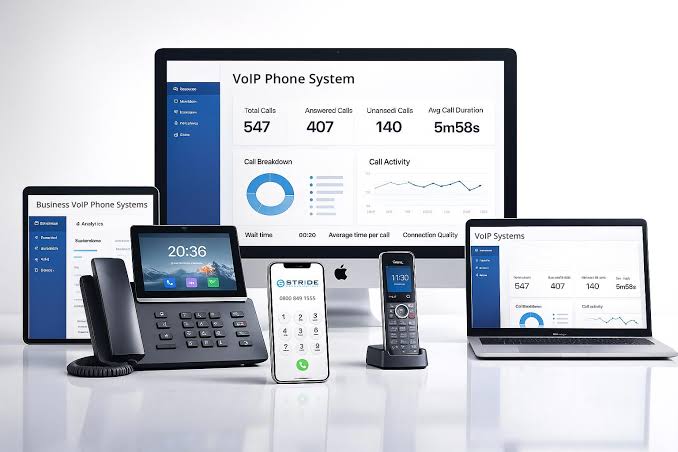
Voice over Internet Protocol, commonly known as VoIP, enables telephone calls to be made and received through an internet connection.
A hosted VoIP system may provide features such as:
- Business extensions
- Call routing
- Voicemail
- Auto attendants
- Call groups
- Call forwarding
- Reporting tools
- Desktop and mobile applications
- Support for remote employees
Available features vary between providers and packages.
VoIP can make communication more flexible, particularly for organisations operating from multiple locations or supporting hybrid working. However, because digital phone services depend on power and connectivity, businesses should also discuss backup arrangements with their provider.
Ofcom confirms that UK landline services are moving towards digital technology using VoIP and broadband connections.
The UK PSTN switch-off: what businesses should know
The UK’s traditional analogue Public Switched Telephone Network is being retired. Openreach states that its analogue network is scheduled to be switched off by 31 January 2027.
This change may affect more than traditional telephone calls. Businesses should identify equipment that may still depend on an analogue line, including:
- Alarm systems
- Lift emergency phones
- Fax machines
- Payment terminals
- Door-entry systems
- CCTV connections
- Telecare equipment
- Building-management systems
Businesses should contact the relevant service providers before migration to confirm that connected equipment will operate correctly with a digital service.
Do not disconnect an existing line until the new service and any connected equipment have been tested.
Can a business keep its existing phone number?
Businesses can often retain existing telephone numbers when moving to another provider through a process known as number porting.
Number portability is regulated in the UK and is intended to allow customers to retain their numbers when changing communications providers.
However, successful porting can depend on:
- The type of telephone number
- The current and new providers
- Correct business and account information
- Existing contractual arrangements
- The services connected to the number
Tell the new provider that you want to retain your number before cancelling the existing service. Cancelling too early could complicate the transfer.
What should businesses compare?
A suitable broadband and telecom package should be judged on more than its headline monthly price.
Connection availability
Not every service is available at every address. Check whether the location supports full fibre, leased lines or other business connectivity options.
Performance requirements
Consider download speed, upload speed, latency and the number of people who will use the connection simultaneously.
Reliability and resilience
Businesses that cannot operate without internet access should ask about backup connections, mobile failover and fault-response arrangements.
Telecom features
Determine whether the organisation needs extensions, call queues, auto attendants, recording, reporting, mobile applications or integration with other business systems.
Support
Review when support is available, how faults are reported and whether response or restoration targets are included.
Contract terms
Check:
- Minimum contract duration
- Installation charges
- Equipment costs
- Renewal terms
- Notice periods
- Early termination charges
- Price-adjustment clauses
Future growth
Choose a solution that can accommodate additional employees, devices, telephone numbers or business locations.
Questions to ask before switching
Before accepting a new package, ask the provider:
- What services are available at our address?
- What estimated speeds and upload performance should we expect?
- Is the connection shared or dedicated?
- Which router, handset or other equipment is included?
- What support and service-level commitments apply?
- Can we keep our existing telephone numbers?
- How long will installation and number transfer take?
- Will there be any interruption during migration?
- Are there installation or early termination charges?
- What happens to our phone service during a power or internet outage?
You should also confirm whether your existing contract is still within its minimum term. Ofcom notes that switching before the end of a minimum contract period may result in early termination charges.

Making the right decision
The best broadband and telecom solution is not necessarily the package with the highest speed or the longest list of features.
A small office may need a straightforward full-fibre connection and a few hosted extensions. A multi-site or customer-facing organisation may require dedicated connectivity, advanced call routing, number porting and backup services.
Begin by reviewing how your business currently communicates, where service problems occur and what the organisation may require over the next few years.
A requirements-based comparison can make it easier to identify an appropriate package while avoiding unnecessary features and unsuitable contract terms.
Compare business broadband and telecom options
MO Utilities helps organisations compare business broadband, full-fibre, leased-line and VoIP options based on their locations, users and communication requirements.
Tell us about your existing services and the way your business operates, and our team will help you explore suitable options.